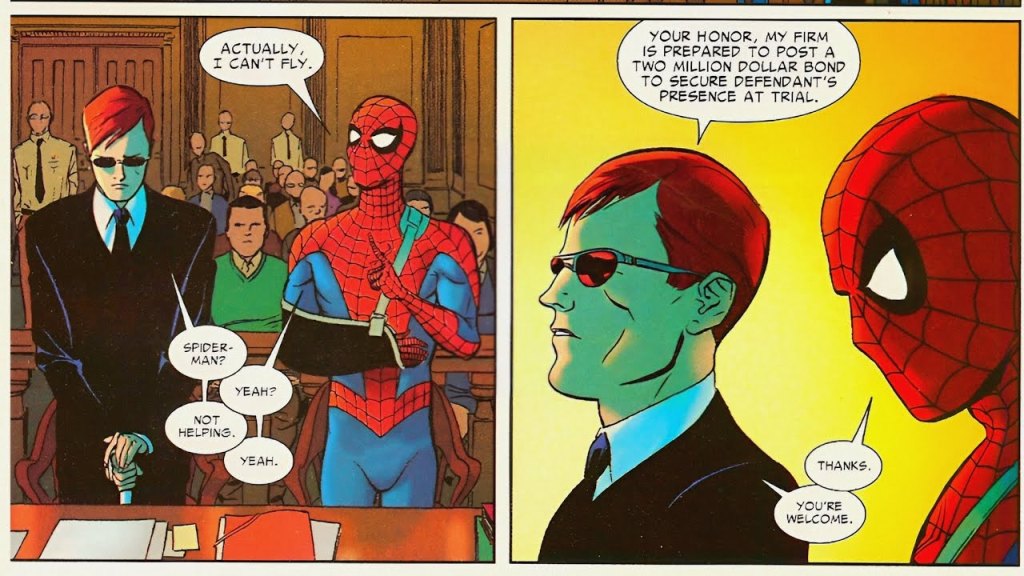
A masked teenager swings through New York, stops armed robbers, web-binds suspects to lamp posts, and sometimes leaves a trail of broken glass,
smashed cars, and collateral damage. The public cheers on good days and panics on bad ones. Police tolerate him, then resent him, then need him.
If this were not a comic-book world, the question lands fast: is Spider-Man a hero… or a defendant?
This isn’t about whether his intentions are good. Law is rarely impressed by intentions alone. It asks narrower, harsher questions: what offences were committed,
what harms were caused, what duties were owed, and what defences are realistically available. Then it asks an even more practical question:
can any of this be proven against someone who refuses to be identified?
Table of contents
- The starting point: vigilantism is not a legal status
- Criminal exposure: what could he be charged with?
- Civil liability: who pays for the damage?
- Defences: necessity, defence of others, and the “reasonable force” ceiling
- Citizen’s arrest and the problem with webbing people to walls
- Evidence and enforcement: the mask is a litigation strategy
- So what would a real legal system do with him?
- A realistic verdict
The starting point: vigilantism is not a legal status
There is no lawful category called “friendly neighbourhood superhero.” In ordinary legal systems, a private person using force, restraining others,
or inserting themselves into violent events is simply a civilian. Sometimes a civilian acting lawfully. Often a civilian taking legal risks.
Police officers have statutory powers and institutional protections. Private citizens do not. That difference matters because Spider-Man routinely does things
that law normally reserves for the state: stopping suspects, restraining them, chasing them across public spaces, seizing weapons, entering buildings.
The moral story may be flattering. The legal story is less generous.
Criminal exposure: what could he be charged with?
Use of force offences (assault, battery analogues, reckless endangerment)
Start with the obvious: Spider-Man hits people. He also throws them, slams them, webs them, suspends them from heights, and sometimes disables vehicles mid-flight.
Even when the target is a criminal, the baseline legal rule is simple: intentional, non-consensual force can be criminal unless justified.
“They deserved it” is not a doctrine. It’s a vibe.
Prosecutors would look for moments where force exceeds what was necessary: continuing to strike after a threat is neutralised,
creating serious risk to bystanders, or using methods that could predictably cause injury (high-altitude dangling is not exactly a gentle restraint technique).
Reckless endangerment theories are particularly tempting in a crowded city.
Unlawful imprisonment / coercive restraint
Webbing a suspect to a wall is restraint. Leaving them there, even “for the cops,” is restraint for a non-trivial period.
That can map onto unlawful imprisonment-style offences, especially if the underlying suspicion is wrong or the restraint is excessive in duration or danger.
The more humiliating and public the restraint, the more likely a court takes it seriously as coercive.
Property offences (criminal mischief, trespass, breaking-and-entering analogues)
Glass shattered during a fight, a collapsed rooftop, a wrecked storefront, a flipped truck—property damage isn’t morally erased by good motives.
It is also not automatically excused because the villain started it. Criminal mischief charges become plausible when the damage is substantial and avoidable,
or when Spider-Man enters private premises without consent (to chase, to investigate, to ambush).
Obstruction and interference with law enforcement
Even if he helps, he may also interfere. Taking over a scene, pursuing suspects against police instructions, moving evidence, interrogating a suspect,
or using methods that compromise chain of custody can be framed as obstruction. Not every jurisdiction would be eager to prosecute a popular hero for this.
But the legal hook exists, and it becomes sharper the moment a case collapses because evidence was mishandled.
Key idea: criminal liability is not about the “hero label.” It’s about discrete acts: force, restraint, damage, trespass, interference.
A prosecutor doesn’t need to prove he’s bad. Only that he crossed legal lines without a valid defence.
Civil liability: who pays for the damage?
Civil law is often harsher than criminal law because it doesn’t need to prove guilt “beyond reasonable doubt.”
It asks whether someone caused harm in a legally blameworthy way and whether compensation is owed.
In a Spider-Man world, the civil docket would be endless.
Negligence: the collateral damage problem
If Spider-Man causes foreseeable harm through unreasonable risk-taking, negligence claims follow:
bystanders injured by debris, motorists hit during airborne chases, property owners whose buildings become battlegrounds.
The fact that the villain is dangerous doesn’t automatically absolve Spider-Man. Courts would ask:
did his intervention reduce or increase the risk compared to the alternative? Could he have acted differently?
Was this the least dangerous way to achieve the same protective aim?
Intentional torts: battery, trespass to land, trespass to chattels
Webbing someone’s hands and feet to immobilise them is intentional contact in legal terms. So is swinging a criminal into a billboard.
Entering private property without permission, even in pursuit, can trigger trespass. Grabbing and discarding a weapon can trigger interference with property.
The courtroom doesn’t run on cinematic logic. It runs on elements, causation, and defences.
Who sues, realistically?
The obvious plaintiffs are the injured bystanders and property owners. The awkward plaintiffs are the suspects themselves.
A person committing a crime can still sue for excessive force or unreasonable restraint. That irritates public opinion.
Courts do not care.
Then there’s the institutional question: does the city ever try to recover costs? Emergency services, infrastructural damage, public-order expenditures.
Governments sometimes pursue cost recovery in narrow contexts. A city might be tempted if the destruction is recurring and attributable to one identifiable actor.
Identifiable is doing a lot of work there. The mask is not fashion; it’s liability insulation.
Defences: necessity, defence of others, and the “reasonable force” ceiling
The strongest legal case for Spider-Man is defensive. He rarely initiates violence in the clean sense; he responds to threats.
So the core defences would be some mix of self-defence, defence of others, and necessity.
Defence of others
Many legal systems permit a person to use reasonable force to protect someone else from unlawful force.
That maps neatly onto “stopping an armed robbery” or “preventing an imminent attack.”
But it is not a blank cheque. The force must be proportionate to the threat as perceived in the moment.
Once the threat is neutralised, continued force becomes punishment, and punishment is supposed to be the state’s business.
Necessity
Necessity is the legal doctrine that tries to handle emergency trade-offs: breaking a rule to prevent a greater harm.
It can justify acts like forcing entry to stop violence or damaging property to avoid immediate catastrophe.
Courts usually treat necessity cautiously because it can swallow the rule if handled loosely.
Still, for a superhero scenario—where seconds matter and institutional response is too slow—necessity becomes the most plausible bridge
between what feels morally right and what is legally defensible.
The ceiling: reasonableness and proportionality
Every defence here has a ceiling. In practice, Spider-Man’s liability would hinge on moments where he exceeds it:
excessive restraint, humiliating or dangerous detention methods, avoidable bystander risk, and damage that looks unnecessary rather than incidental.
Law can forgive a lot under pressure. It does not forgive everything.
Citizen’s arrest and the problem with webbing people to walls
A common attempt to “legalise” Spider-Man is to treat him as performing citizen’s arrests.
Many jurisdictions allow some form of citizen’s arrest, especially for serious offences or for crimes committed in one’s presence.
On paper, that sounds like a neat fit.
In practice, citizen’s arrest is a legal minefield. If the suspicion is wrong, the arrester can be exposed to civil claims and even criminal liability.
Even if the suspicion is right, the arrest must be carried out in a reasonable manner. Webbing someone to a wall for public display,
leaving them unattended, suspending them from heights, restraining them in ways that risk injury—those facts create legal vulnerability fast.
The more theatrical the method, the less “reasonable” it looks in court.
Evidence and enforcement: the mask is a litigation strategy
Here is the blunt reality: even if offences and torts exist on paper, enforcement depends on identification and proof.
Suing “Spider-Man” as a nickname is not the same as suing a person with assets. Prosecuting a masked actor requires evidence that can survive
procedural scrutiny. Spider-Man tends to work at speed, at height, at night, leaving chaos and unreliable witnesses.
That is not friendly to prosecution.
It gets worse. If Spider-Man collects evidence, moves weapons, or restrains suspects before police arrive, the defence can argue contamination,
broken chain of custody, compromised identifications. A prosecutor might appreciate the hero’s help and simultaneously dread it.
Two feelings can coexist. Courts will not rescue the state from sloppy evidence just because the suspect is unsympathetic.
So accountability becomes selective: public condemnation, political pressure, maybe occasional targeting when something goes terribly wrong.
Full, consistent legal accountability is unlikely unless he is unmasked or formally integrated into lawful structures.
So what would a real legal system do with him?
A real system that keeps facing superhuman threats tends to adapt. It doesn’t keep pretending the problem is merely “vigilantism.”
It creates frameworks: deputisation models, special oversight units, regulated cooperation agreements, reporting duties,
restrictions on methods of restraint, compensation funds for collateral damage, insurance schemes, and clear lines for when force is authorised.
That is basically the “Sokovia Accords” instinct in legal form: not because bureaucracy is cool, but because unregulated coercive power—even benevolent—
is politically and legally unstable. The state either absorbs the actor into accountable structures or eventually tries to crush the actor as a rival authority.
Coexistence without rules is not a long-term plan. It’s a pause.
A realistic verdict
Could Spider-Man be held accountable? Yes, in principle. The legal theories are not hard to build: excessive force, unlawful restraint,
reckless endangerment, property damage, trespass, obstruction. Civil suits for negligence and intentional torts would be routine.
Would he be held accountable in practice? Not consistently, not until identification becomes possible, and not unless the political climate flips.
In most scenarios, law would tolerate him until a catastrophic event forces a reckoning. Then the same system that benefited from the hero narrative
would rediscover the language of legality: monopoly on force, due process, oversight, accountability.
That is the core tension. Spider-Man’s morality is individual. Law’s morality is institutional. When those two align, he looks like a saviour.
When they diverge, he looks like a problem the system must solve.
Series note: “Pop Culture in Trial” works best when it refuses the easy answer.
The hard truth here is that Spider-Man can be both: socially beneficial and legally risky, heroic and legally liable, admired and still accountable.

Leave a comment