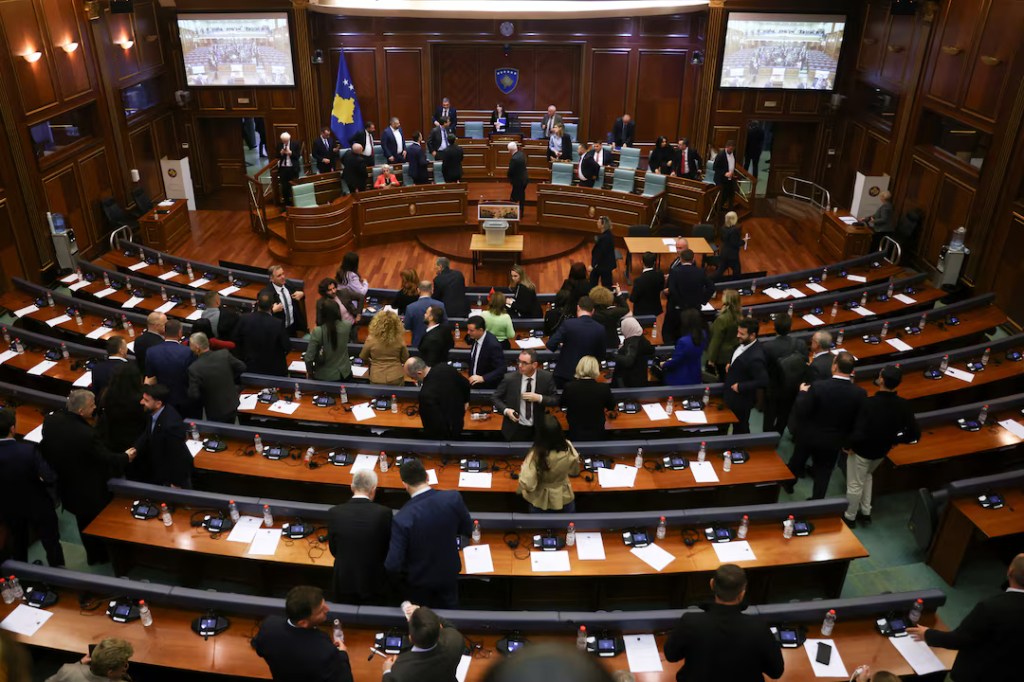
A country that spent most of 2025 unable to form a government has now failed to elect a president. Its head of state seat sits empty. Its parliament is racing a court-imposed deadline. And the actors responsible for resolving the crisis are the same ones who created it.
Kosovo declared independence in 2008. It has spent a striking portion of the years since in constitutional limbo — and April 2026 is shaping up to be its most serious institutional crisis yet. What is unfolding is not simply a political dispute. It is a stress test of whether Kosovo’s constitutional architecture can survive the ambitions of the politicians who operate within it.
The Setup: A Constitution Built for Consensus
To understand why Kosovo is in crisis, you first need to understand how its president is chosen. Unlike most European democracies, Kosovo does not elect its president by popular vote. The president is chosen indirectly by the 120-member Assembly — making the process, as one analyst put it, “primarily a politically negotiated process, not a campaign with public debates and a popular vote.”
The voting thresholds are deliberately demanding. In the first two rounds, a candidate needs 80 out of 120 votes — a two-thirds supermajority. If no one reaches that bar, a third round is held between the top two candidates, requiring only a simple majority of 61. Fail that too, and the Assembly is automatically dissolved, triggering new parliamentary elections within 45 days.
The logic behind such high thresholds is sound in theory: a president who represents a multi-ethnic, post-conflict society should command broad legitimacy, not just a slim majority. In practice, however, supermajority requirements are a gift to political actors who prefer obstruction to compromise. They hand enormous leverage to opposition parties — and Kosovo’s opposition has shown few inhibitions about using it.
The Timeline: A Year of Self-Inflicted Wounds
The 2026 presidential crisis did not emerge from nowhere. It is the latest chapter in a saga of institutional dysfunction that has consumed Kosovo since early 2025.
- Feb 2025 Parliamentary elections produce a hung parliament. No party can form a government. Kurti’s Vetëvendosje remains largest party but falls short of a majority.
- Apr–Aug 2025 Kosovo fails to elect a Speaker of the Assembly for four months. The country enters a prolonged institutional paralysis.
- Oct–Nov 2025 Two attempts to form a Vetëvendosje government fail. Parliament is dissolved. Snap elections are called for 28 December.
- Dec 2025 Vetëvendosje wins decisively with 51% of the vote and 57 seats — but still short of the 61 needed for a majority. Kurti sworn in for a third term in February 2026.
- 5 Mar 2026 The first presidential vote fails. Opposition parties boycott the session. Only 66 of 120 MPs are present — 14 short of the required quorum of 80.
- 6 Mar 2026 President Osmani issues a decree dissolving the Assembly, triggering snap elections. Vetëvendosje immediately challenges the decree at the Constitutional Court.
- 25 Mar 2026 The Constitutional Court strikes down Osmani’s dissolution decree as unconstitutional. A mandatory 34-day deadline is set: the Assembly must elect a president by 28 April.
- 5 Apr 2026 Osmani’s term expires. No successor has been elected. The Speaker of the Assembly assumes the role of acting head of state.
The Boycott: Democratic Participation as a Weapon
The immediate trigger for the crisis was the opposition boycott of the 5 March parliamentary session. The Democratic Party of Kosovo (PDK), the Democratic League of Kosovo (LDK), and the Alliance for the Future of Kosovo (AAK) all refused to attend, citing Vetëvendosje’s insistence on its own candidate — Foreign Affairs Minister Glauk Konjufca — without genuine cross-party consultation.
Their grievance has some merit. The LDK stated that prior cross-party meetings were specifically intended to find a unifying, consensual candidate. Vetëvendosje’s unilateral nomination of Konjufca was seen as a breach of that understanding. The opposition’s position is, in essence: we will not legitimise a process designed to produce a foregone conclusion.
But here is the harder question: is parliamentary boycotting a legitimate democratic tool, or is it a form of constitutional sabotage?
There is a reasonable argument for both. Boycotts have a long history in parliamentary democracies as a form of protest against processes perceived as rigged or captured. When minority parties face an arithmetic wall — knowing that even a united opposition cannot overcome a ruling party’s numerical advantage in a third round — abstention may feel like the only meaningful form of resistance available.
Yet the counter-argument is equally compelling. A constitution is not a menu. If MPs can simply absent themselves to prevent quorum whenever a vote does not favour them, the entire framework of parliamentary democracy is hostage to the most obstructive faction in the room. Democratic systems function on the premise that actors accept outcomes they dislike — not that they paralyse the institution to avoid them.
Kosovo’s Constitutional Court attempted to address this directly. The Ministry of Justice formally requested that the Court mandate all MPs to attend and vote — whether in favour, against, or abstaining — as a binding constitutional duty. The Court, it seems, declined to go that far. Whether that restraint was wisdom or a missed opportunity is a debate Kosovo’s legal scholars will be having for years.
The Osmani Move: A President Overreaches
President Osmani’s response to the failed vote deserves scrutiny of its own. The morning after parliament failed to reach quorum, she issued a decree dissolving the Assembly and called for snap elections within 45 days.
On the surface, this might seem like a president doing her constitutional duty in the face of institutional failure. Look closer, and the picture becomes more complicated.
Under Article 86 of Kosovo’s Constitution, the presidential election process allows a 60-day window from the initiation of the procedure — meaning until 4 May 2026 — for the Assembly to elect a president through up to three rounds of voting. Osmani dissolved parliament on day one of that window, citing a failure that had not yet exhausted its constitutional remedies.
The Constitutional Court agreed. On 25 March, it struck down her decree as unconstitutional, with former Constitutional Court President Enver Hasani stating that the unconstitutionality of the move was “legally obvious.” The Court re-established the 60-day timeline, resetting the deadline to 28 April.
One cannot ignore the political context here. Osmani was elected in 2021 on a joint ticket with Kurti and Vetëvendosje, but relations between the two have since deteriorated sharply — most visibly when Osmani joined Kosovo to the Trump Peace Council without coordinating with the prime minister. A dissolution decree that triggered new elections, rather than allowing the 60-day process to play out, would have served her political interests: either forcing a new parliament more amenable to her re-election, or at minimum denying Kurti the ability to install a loyalist in her place before her term expired.
The Kurti Factor: Consolidation of Power or Political Pragmatism?
No serious analysis of this crisis can avoid asking what Albin Kurti actually wants from it.
Kurti has now won four consecutive parliamentary elections. His party controls the government. His ally controls the Assembly speakership. The one institution not yet in Vetëvendosje’s orbit is the presidency — and with Osmani’s term expiring, that is precisely what is now in play.
Analysts have been direct about what this means in practice. Kurti, one report noted, “needs a full loyalist for the presidency who will in no way threaten the consolidation of power he seeks — control over the legislative, executive, and presidential branches.” The nomination of Konjufca, a senior Vetëvendosje figure, fits this pattern.
Kurti’s defenders would argue this is simply politics — a democratically elected majority asserting its right to shape institutions. His critics would call it something more troubling: the systematic capture of every meaningful lever of state power by a single party and its leader. The distinction matters enormously, and it is not one that legal texts alone can resolve.
What makes this particularly delicate is the international dimension. The EU and the United States are closely watching the process — not just because of democratic governance concerns, but because the new president will be expected to play a key role in Kosovo’s dialogue with Serbia, including the contentious issue of the Association of Serbian Municipalities. A president who is Kurti’s unconditional ally may give the prime minister tighter control over that process — which is exactly what Kosovo’s Western partners are trying to guard against.
The Deeper Legal Question: Is Kosovo’s Constitution Fit for Purpose?
Beneath all the political manoeuvring lies a more fundamental question that Kosovo’s crisis forces into the open: is the constitutional framework itself part of the problem?
Kosovo’s constitution was drafted in 2008 under heavy international supervision, with the explicit goal of protecting minority rights and preventing single-party dominance. The supermajority requirements for electing a president were designed with exactly this in mind. History has shown, however, that such mechanisms can be weaponised just as easily by bad-faith actors as they can be used to protect genuine minority interests.
The 2011 presidential election stalled for months before a compromise candidate was found. The 2021 election required multiple rounds. Now 2026 threatens to be worse than both. This is not a pattern of bad luck. It is a systemic design flaw — a constitution that demands consensus from actors who have little incentive to provide it, and provides no meaningful enforcement mechanism when they refuse.
Constitutional amendment in Kosovo is itself almost impossibly difficult, requiring a double two-thirds majority including at least 14 of the 20 reserved minority seats. The Serb List — aligned with Belgrade — has little interest in making Kosovo’s institutions run more smoothly. Reform, in other words, is constitutionally trapped.
The Bottom Line
Kosovo’s presidential crisis is not simply a story about bad politicians failing to cooperate. It is a story about a constitutional system that incentivises obstruction, a presidency whose vacancy creates a power vacuum that every major actor wants to fill on their own terms, and a country that has now spent the better part of two years in near-continuous institutional paralysis. The 28 April deadline will either produce a president — likely one hand-picked by Kurti — or it will produce Kosovo’s fifth election in little over a year, with no guarantee the next parliament will do any better. Either way, the real loser is not any particular party. It is the Kosovar citizen watching yet another constitutional process fail to deliver the basic stability a young democracy needs to survive.
What to Watch
As the 28 April deadline approaches, several developments are worth tracking closely:
- Will Vetëvendosje withdraw Konjufca’s candidacy? Following the Constitutional Court ruling, LVV has the right to withdraw its nominees and propose new ones. A surprise consensus candidate could unlock opposition participation and break the deadlock.
- Will the opposition engage? The PDK has said there is no reason to negotiate while LVV’s current candidacies remain in place. If those are withdrawn, the opposition’s justification for boycott collapses.
- What role will the EU and US play? Western pressure has historically been a decisive factor in resolving Kosovo’s political deadlocks. Whether Washington under Trump remains engaged enough to apply that pressure is an open question.
- What happens if the deadline is missed? Another election would be Kosovo’s fifth in roughly fourteen months. The political and economic cost of continued instability — including the risk to nearly €1 billion in EU and World Bank funding — may ultimately prove more persuasive than any constitutional argument.

Leave a comment