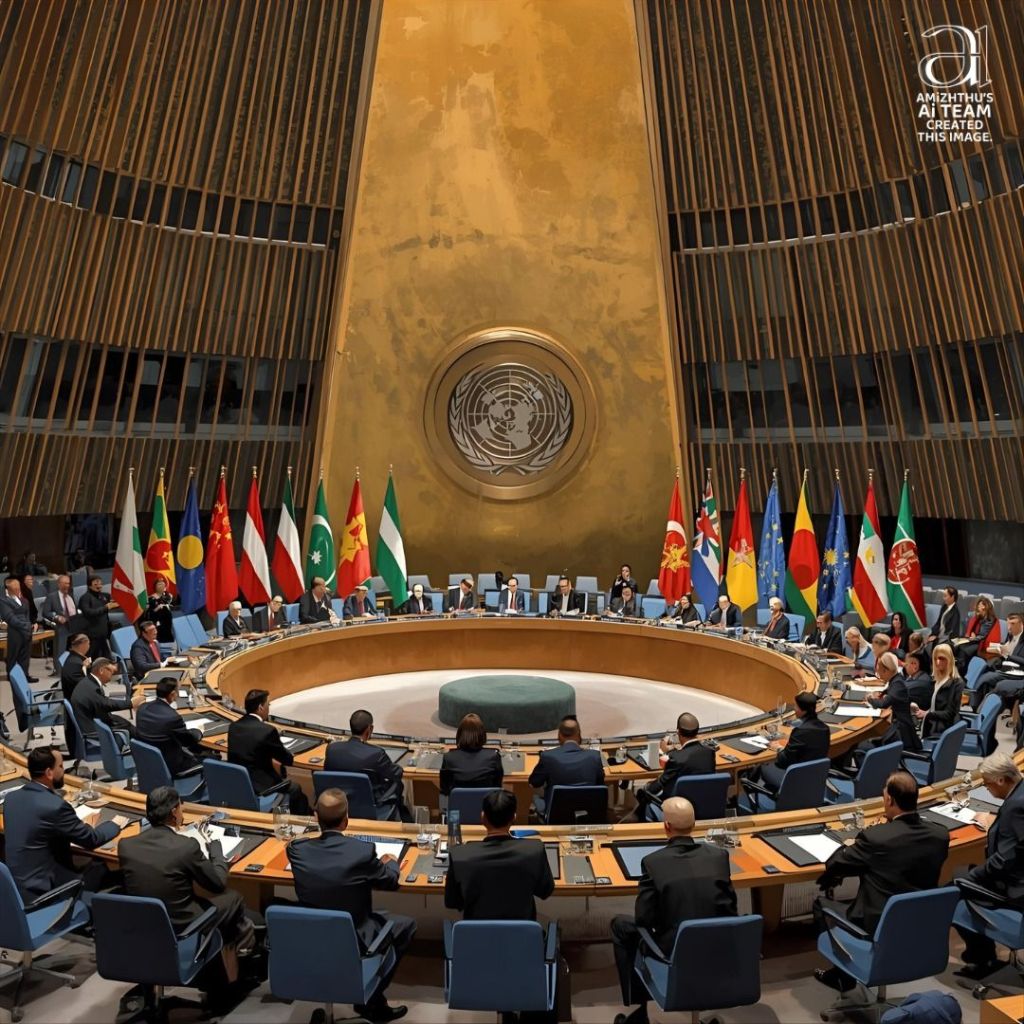
A state breaches an international obligation.
Other states respond. Statements are issued. Legal arguments are advanced. Sometimes sanctions follow. Often, they do not.
No central authority intervenes. No uniform consequence is guaranteed.
This recurring pattern gives rise to a familiar question:
Is international law truly enforceable—or does it operate within structural limits that distinguish it fundamentally from domestic legal systems?
A system grounded in consent
International law possesses the formal attributes of a legal system. Its sources are authoritatively set out in Article 38(1) of the Statute of the International Court of Justice (ICJ): treaties, customary international law, and general principles of law.
Yet its structure departs from domestic legal orders in a decisive respect.
There is no central legislature with general competence. No executive authority capable of coercive enforcement across all subjects. No court with compulsory jurisdiction over all disputes.
Instead, the system is premised on state consent. Treaty obligations bind only those states that accept them. Customary rules emerge from general practice accompanied by opinio juris.
This is not a defect in design. It is the organising principle of the system.
Enforcement without centralisation
The absence of a central authority does not imply the absence of enforcement. It alters its form.
Judicial enforcement exists, but conditionally. The ICJ may resolve disputes only where jurisdiction has been accepted, whether through compromissory clauses or declarations under Article 36(2) of its Statute.
Collective enforcement mechanisms are also available. Under Chapter VII of the UN Charter, the Security Council may adopt binding measures, including sanctions and, in principle, the authorisation of force. Yet this mechanism is structurally contingent on political agreement among permanent members, as reflected in repeated deadlock in situations such as Syria.
Beyond formal institutions, enforcement operates through decentralised mechanisms. States may adopt countermeasures in response to internationally wrongful acts, as codified in the Articles on Responsibility of States for Internationally Wrongful Acts (ARSIWA). Diplomatic pressure, economic retaliation, and reputational costs function as indirect but persistent constraints.
Enforcement, therefore, is neither absent nor uniform. It is dispersed, conditional, and often mediated through political structures.
Compliance and the role of legal expectation
Empirical observation complicates the assumption that weak enforcement entails widespread non-compliance.
In Military and Paramilitary Activities in and against Nicaragua (Nicaragua v United States), the ICJ reaffirmed that the existence of breaches does not negate the normative status of rules. States continue to articulate their conduct in legal terms, even where violations occur.
Much of international law operates in domains where compliance is routine: aviation, maritime navigation, diplomatic relations, and international trade. These regimes function not because enforcement is constant, but because coordination is mutually beneficial and deviation carries systemic costs.
Legal obligation is therefore reinforced by expectation. States operate within a framework in which compliance sustains stability, while persistent deviation undermines credibility and reciprocity.
Power and the uneven operation of law
The principle of sovereign equality coexists with material inequality.
In practice, the capacity of states to resist enforcement varies significantly. Economic strength, military capability, and geopolitical position influence both the likelihood of enforcement and its effectiveness.
This dynamic is evident in the selective application of sanctions and the variable compliance with international judgments.
Yet it would be reductive to conclude that power displaces law. Rather, power conditions how law operates. Legal rules continue to structure argument, justify action, and define the boundaries of acceptable conduct.
Breach, justification, and the persistence of legality
A notable feature of international practice is that states rarely reject legal frameworks outright. Instead, they contest their application.
They invoke self-defence under Article 51 of the UN Charter. They dispute the existence of customary norms. They argue necessity, proportionality, or jurisdictional limits.
This behaviour is doctrinally significant.
It reflects what has been described as the “pull of legality”: even where rules are breached, they remain the reference point against which conduct is assessed. The language of law persists as the medium of justification.
Structural limits, not absence of law
International law is not enforced in the manner of domestic legal systems. It lacks a centralised coercive apparatus capable of guaranteeing compliance in every instance.
But it is not merely aspirational.
It is a system in which obligation, interest, and institutional structure interact. Rules facilitate coordination, reduce uncertainty, and provide a framework within which disputes are articulated and assessed.
The more precise conclusion is therefore not that international law is unenforceable, but that it is structurally limited.
Its effectiveness depends on consent, reciprocity, institutional design, and the distribution of power. Within those constraints, it continues to shape behaviour, structure expectations, and define legality in international relations.
And in a system without a central authority, that function is not incidental.
It is constitutive of the system itself.

Leave a comment